
Vocational Education and Training (VET) in Catalonia is undergoing a period of transformation and new opportunities. This was the starting point of the event “Individual Trajectories and Collective Challenges: A Vision of VET in Catalonia”, presented by Xavier Rambla and Paulina Robalino from the Universitat Autònoma de Barcelona (UAB), within the framework of the AIVET project.
The event forms part of the dissemination activities of AIVET, a European initiative that brings together universities, institutions and organisations from Barcelona, Sofia and Vienna with the aim of enhancing the understanding of educational and labour market trajectories and contributing to the development of more effective policies and practices in the field of VET.
The findings underscore the importance of understanding individual educational and employment pathways in order to address broader collective challenges. By shedding light on these trajectories, the research contributes to building a more inclusive and responsive VET system, one that is better aligned with labour market needs and equipped to meet the demands of the future.
Research Based on Data and Experiences
The study combines several sources of information to provide a comprehensive view of VET in Catalonia:
- Administrative records of nearly 59,000 students who completed workplace training placements between 2020 and 2023, obtained from the Chamber of Commerce’s qBID system.
- Interviews with 42 VET students and graduates.
- Discussions with nine internship coordinators and 17 employers from different sectors.
This combination of quantitative and qualitative data makes it possible to understand not only individual trajectories but also the structural challenges affecting the VET system.
Individual Trajectories: Motivations and Expectations
The research shows that students’ motivations vary according to age and vocational field. Young people choosing technological pathways often emphasise their interest in innovation and professional development opportunities, while in areas such as healthcare and hospitality, service-oriented values and expectations of academic and career advancement also play an important role.
The analysis also highlights gender inequalities across sectors, with greater male representation in Energy and ICT programmes and a more balanced distribution in Healthcare and Hospitality.
Collective Challenges for the VET System
Among the main challenges identified are:
- Short-term labour market integration and its connection with employment policies.
- The acquisition of technical and transversal skills tailored to the needs of each sector.
- The organisation and integration of workplace training within companies and institutions.
- The need to respond to demographic changes and the increasing demand for qualified professionals.
The findings show that these challenges differ across vocational fields. In technological sectors, talent demand and generational replacement are creating new opportunities, while service sectors—particularly hospitality and healthcare—face challenges related to professionalisation and the management of internships and workplace learning.
Exploring the Data through Power BI
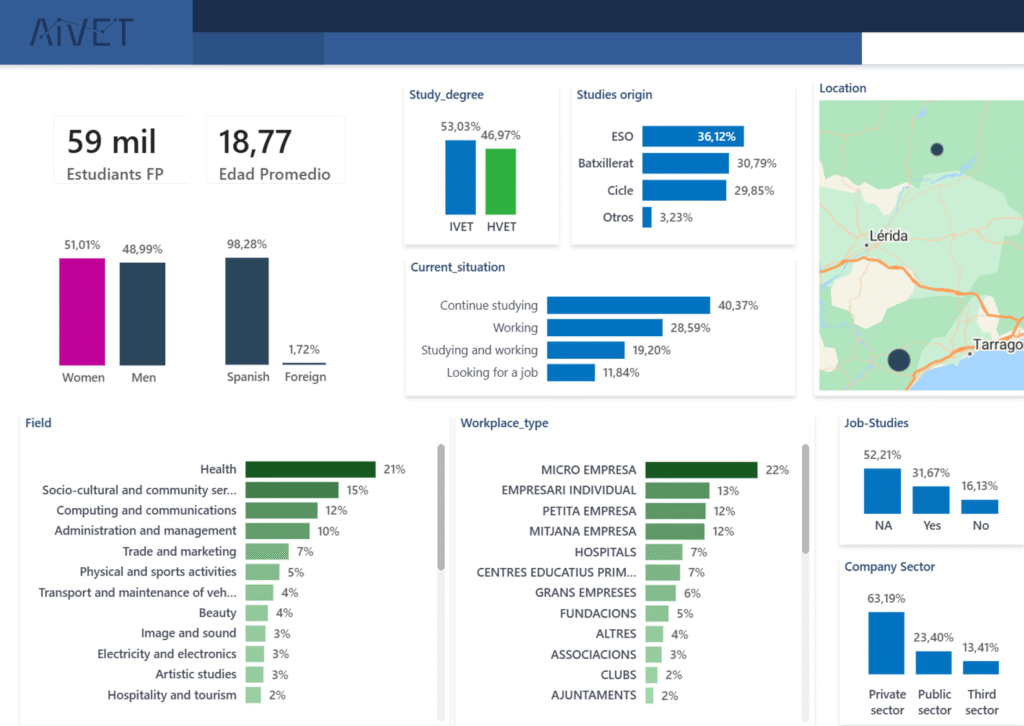
One of the key features of the project is the use of Power BI, an interactive tool that enables users to visualise and analyse the data in greater depth. Through this platform, it is possible to explore socio-demographic profiles, student trajectories and the different patterns identified by the research.
We encourage all interested stakeholders to discover and explore the findings through the AIVET Dashboard: Understanding Educational Trajectories, which provides an interactive and user-friendly way to gain deeper insights into the evolution of Vocational Education and Training in Catalonia.
You can download the presentation of the event “Individual Trajectories and Collective Challenges: A Vision of VET in Catalonia” in either Catalan or English. The presentations provide an overview of the main findings and insights discussed during the event, held in Barcelona on 17 June 2026, as part of the dissemination activities of the AIVET project.