

In the first round of our Delphi study, 12 Barcelona experts shared their views through a questionnaire aligned with parallel studies in Sofia and Vienna. Their responses were analysed qualitatively to identify key ideas on how artificial intelligence (AI) can support young people transitioning from vocational education and training (VET) into the labour market.
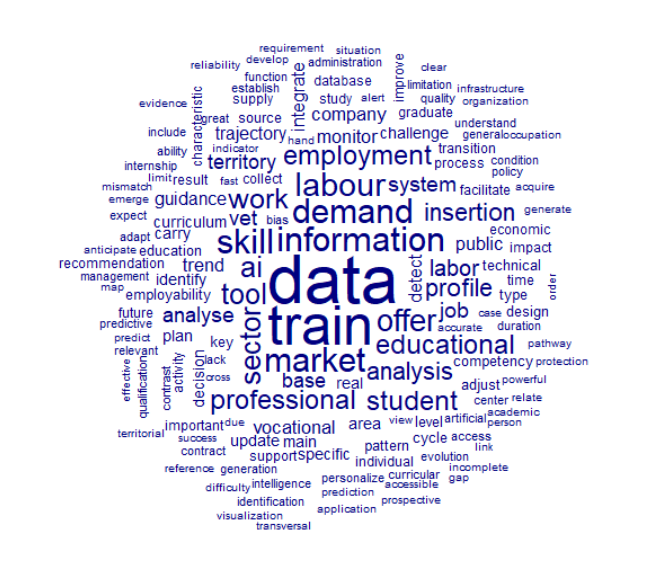
Experts broadly agreed that AI has strong potential to improve VET-to-work transitions. They highlighted its capacity to forecast training and career pathways, detect gaps between what VET programmes offer and what employers require, and enable more personalised career guidance. At a broader system level, AI can reinforce curriculum planning, strengthen policy design, and support targeted job-placement strategies. However, they stressed that its effectiveness depends on high-quality, standardised and interoperable data, and on combining AI-generated insights with the expertise of guidance professionals.
Where AI Could Add Value in Organisations
Experts also described how AI could benefit different types of organisations. Even when the operational impact may be limited, AI-generated information on graduate outcomes can meaningfully enhance research, advocacy, and strategic planning. It can help identify emerging occupational profiles, guide curriculum renewal, support reskilling initiatives, and improve resource management through dashboards and automated monitoring tools.
Barriers and Challenges
Despite this potential, experts pointed to several constraints that could limit the development and uptake of AI tools:
- Fragmented data systems
- Limited access to reliable datasets
- Biases in the information collected
- Difficulty of connecting quantitative and qualitative inputs.
- Ethical concerns — especially privacy, data protection, and trust in predictive models — remain central.
- Long-term success also requires strong institutional capacities, technological readiness, and a culture of collaboration.
They also emphasised that sustained implementation requires strong institutional capacities, technological readiness, and a culture of collaboration.
To address these challenges, participants underscored the importance of shared, up-to-date data infrastructures capable of linking education, employment, and contextual information. They noted that organisations need solid data governance, analytical capabilities, ethical oversight, and the ability to translate analytical insights into practical decisions.
What Effective AI Tools Should Offer
Experts envisioned AI tools that integrate data from labour observatories, educational records, and job platforms; map acquired skills against real labour-market needs; track graduate trajectories over time; and provide predictive insights into emerging professions. They also highlighted the value of interactive dashboards tailored to different stakeholders, supporting curriculum design, career guidance, and policymaking.
The most valued features include:
- Real-time labour-market integration
- Predictive and prescriptive analytics
- Simulations of policy impacts
- Alerts on skill shortages or supply–demand mismatches
- Intuitive data visualisations
- Strong commitments to transparency, traceability, and ethical use
The consensus rounds clarified which elements experts considered most important.
- Aligning VET curricula with labour-market needs became the top priority, reaching full agreement.
- Predictive analytics on skills and employment trends maintained high support.
- Interest shifted away from tools aimed at individuals — such as career-path simulations or AI chatbots — in favour of system-level intelligence.
- Real-time local labour-market data gained importance.
- Education and training records remained the most essential data sources.
- Support grew for a common European methodological protocol, improving comparability.
- Experts preferred quarterly data updates, while noting that optimal timing depends on the dataset.
- Full consensus was reached on the need for collaboration between education and employment institutions, as well as stronger funding and technical infrastructure.
- Ethical priorities also became clearer: preventing algorithmic bias and strengthening data protection were consistently rated as essential.
Happy to gave my opinion & contributiin to this study!